Description
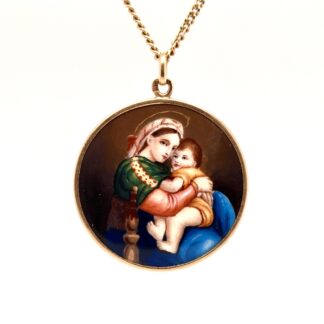
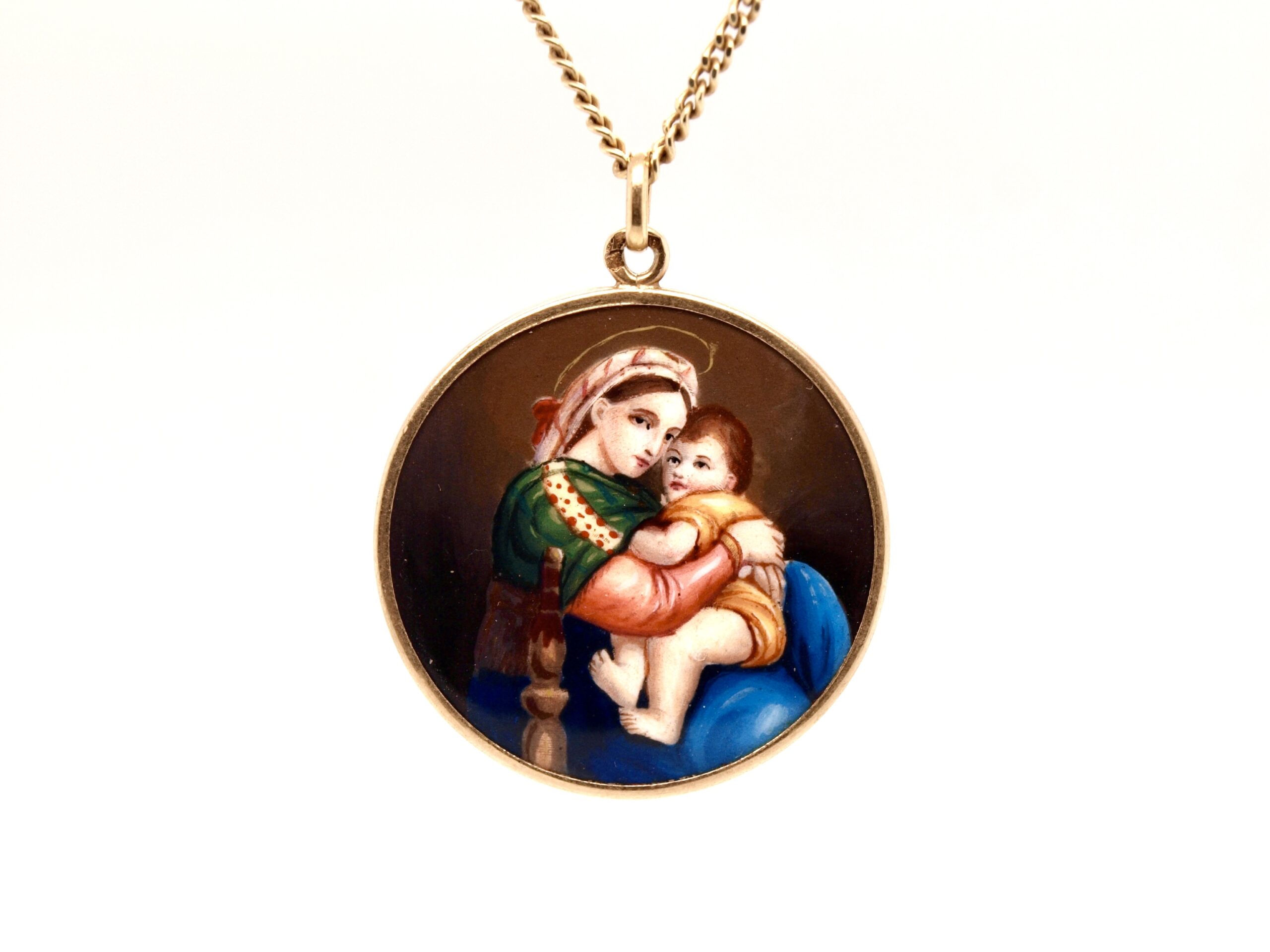
This exceptionally finely crafted pendant combines the arts of goldsmithing, painting, and religious imagery into a small work of art. Set within a frame of 750 gold is a detailed enamel miniature depicting the famous Madonna della Sedia, one of the most celebrated Madonna paintings of the Renaissance. The composition is based on a tondo painting by Raphael, created around 1513–1514, which today ranks among the great treasures of the Palazzo Pitti.
The luminous colors, remarkable delicacy, and the meticulous execution clearly demonstrate the high level of craftsmanship required to produce such miniatures. Unlike printed reproductions or photographs, the motif was painted by hand in enamel colors onto a metal ground and then fired multiple times. This process created the distinctively intense colors and depth that continue to make enamel works so captivating today.
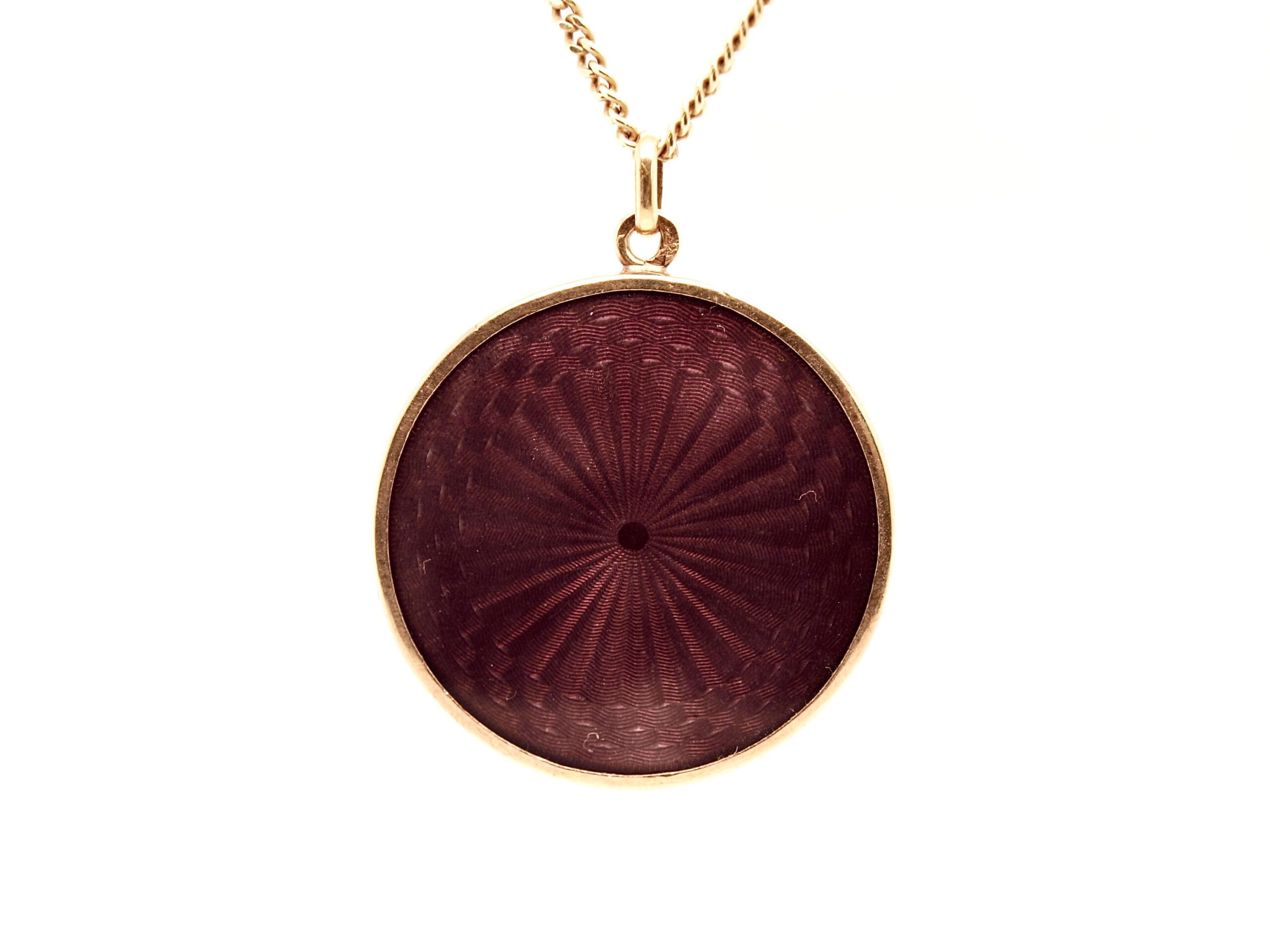
The reverse is an appealing contrast to the figurative front. Beneath transparent violet-red enamel lies a finely guilloché sunburst ornament that reflects light differently depending on the viewing angle. This technique was especially prized during the 19th century and can be found on high-quality jewelry as well as on precious boxes, pendants, and later even on the famous Russian enamel works of Fabergé.
Such pendants enjoyed particular popularity during the late 19th and early 20th centuries. They were frequently acquired by affluent cultural travelers as mementos of Italy. The so-called Grand Tour, which had formed an integral part of European education since the 18th century, brought generations of noble travelers to Florence, Rome, Venice, and Naples. Alongside ancient coins, cameos, and mosaics, enamel miniatures depicting famous works by Raphael, Leonardo, or Murillo were among the most sought-after souvenirs. They allowed their owners to take home a piece of the Italian art world while simultaneously expressing personal faith, education, and refinement.
Especially appealing is the choice of subject. The Madonna della Sedia is regarded as one of the most intimate and human representations of the Virgin Mary created during the Renaissance. Unlike the solemn enthroned Madonnas of earlier centuries, Raphael portrays a mother lovingly embracing her child. It was precisely this emotional closeness that made the picture one of Europe’s most beloved religious painting for centuries.
The pendant is preserved in exceptionally beautiful condition. The enamel remains fresh and vibrant in color, the guilloché work on the reverse retains its full visual effect, and the gold frame presents harmoniously and without alteration. Pieces of this kind unite several collecting fields at once: enamel art, religious iconography, Grand Tour souvenirs, and fine gold jewelry.
A charming example of an era when travel was still regarded as an educational adventure and artistic keepsakes were not merely souvenirs but small portable works of art. Whoever wears this pendant also carries a piece of the Renaissance, a piece of Italy, and the memory of the great tradition of European educational travel.